
Moving from Miami to Cape Coral: Why East Coast Buyers Are Trading the Condo for a Canal (2026)
John Garuti Updated Jul 30, 2026 7 min read
The $45,000 condo assessment letter is how a lot of our clients found Cape Coral. Here's what's actually on the other side of Alligator Alley — and where the trade isn't as good as it looks.

The letter comes on nice letterhead. Your condo association is "pleased to inform you" that after the milestone inspection, your special assessment is $45,000, due in installments, starting next quarter.
You read it twice. You do the math on what you've already paid in monthly dues. And somewhere between the second read and pouring a drink, you open a browser and type "cheaper places to live in Florida."
That's how a lot of our Cape Coral clients got here. Not because they stopped loving Miami — because the number on that letter finally said out loud what their gut had been muttering for two years. So let's talk about what's actually on the other side of the Alligator Alley, and whether the trade is as good as it looks. (Spoiler: mostly, yes. But I'll tell you where it isn't.)
The Letter That Started Your Google Search
Here's the thing nobody selling you a Brickell condo mentioned: Florida changed the rules after Surfside.
Under state law (SB 4-D), every condo building three stories or taller has to complete a milestone structural inspection — at 30 years old, or just 25 if it's within three miles of the coast, which in Miami is a lot of buildings. And the old trick of voting to skip funding your reserves? Gone. As of December 31, 2024, those structural reserves have to be fully funded. No more kicking the can.
The result has been a wave of special assessments across South Florida. Minor projects are landing owners with $5,000 to $15,000 bills. Buildings with real deferred maintenance are hitting $30,000 to $75,000 per unit. And the big multi-system jobs — roof, concrete, waterproofing all at once — have run past $100,000 a door. One 38-story Brickell tower levied $45,000 per unit after a decade of waived reserves.
That's on top of monthly dues that were already climbing and insurance that's been doing its own impression of a rocket launch.
Now here's the part that reframes everything: what if that assessment check was, instead, a down payment on a house nobody can ever hand you a surprise bill for?
Same Money, a Completely Different Life
Let's put the two markets side by side. Real numbers, mid-2026.
| Miami | Cape Coral | |
|---|---|---|
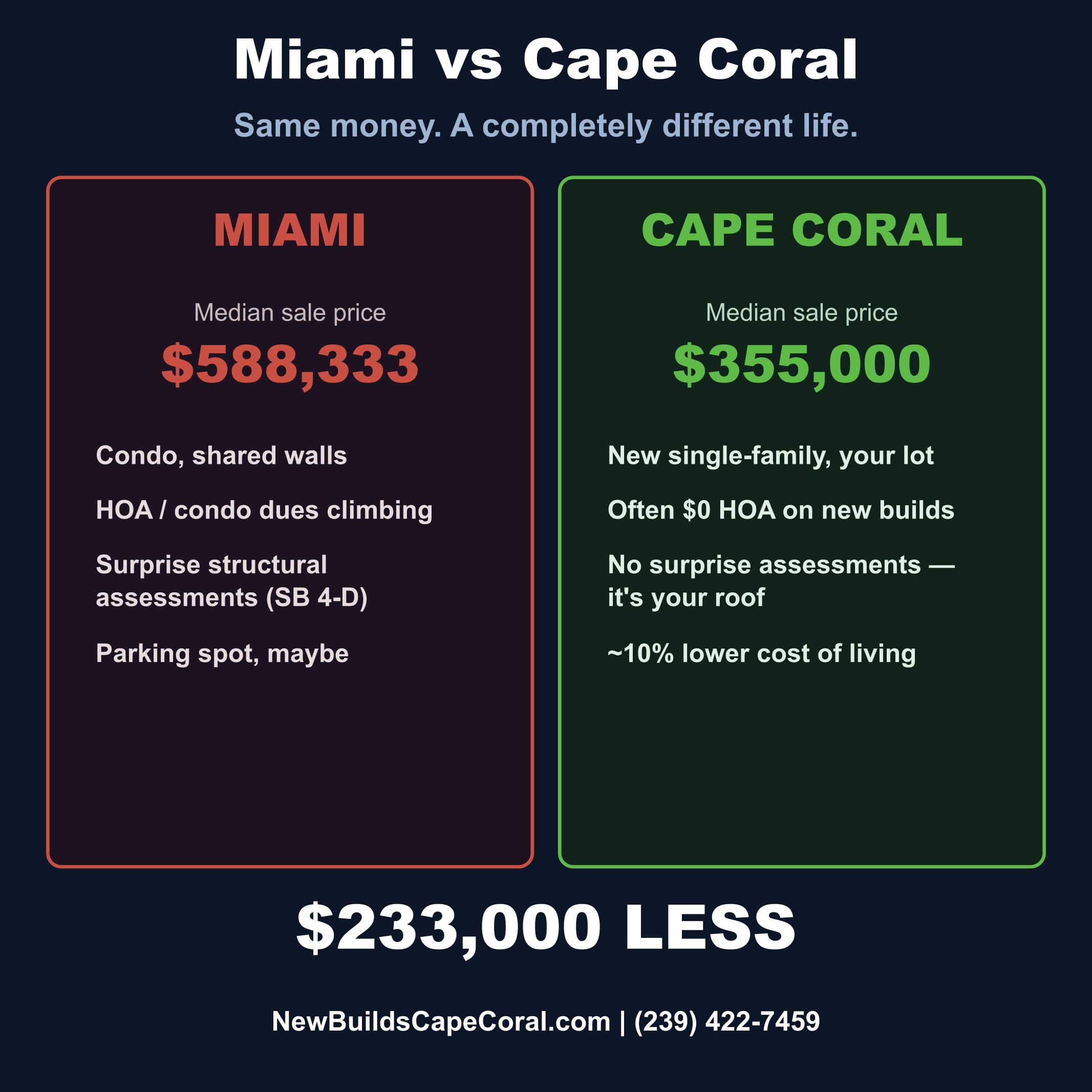
| Median sale price | $588,333 | $355,000 |
| Average home value | $582,621 | $337,346 |
| What you're buying | Condo, shared walls, HOA | New single-family, your own lot |
| HOA / condo dues | Monthly, and climbing | Often $0 on new construction |
| Surprise structural assessments | The whole reason you're reading this | Not a thing — it's your roof |
| Overall cost of living | Baseline | ~10% lower |
Read the top row again. The median Miami home sells for about $233,000 more than the median Cape Coral home. That's not a rounding difference — that's a second property, or a paid-off mortgage, or your kid's college.
And in Cape Coral, that money usually buys a brand-new, single-family house with a two-car garage and a yard, not a slice of a tower with a board that can vote to bill you. Most new construction here carries no HOA at all — no CDD in most of the city, either. The "association" is you, standing in your own driveway.
Want to see the honest inventory? Here's every new build under that Miami down-payment number:
- New construction under $400K — 242 homes right now
- Everything under $500K (still below the Miami median) — 358
It's Closer Than You Think — You Already Drive This Far in Traffic
People picture "moving across Florida" like they're relocating to another time zone. You're not.
Cape Coral is 157 miles from Miami — a straight shot west on I-75 through the Alligator Alley, about three hours without traffic. Be honest: you've spent three hours getting from Kendall to Aventura and back on a bad Friday. This is a Saturday-morning drive with a coffee and a podcast, and you're pulling into your new driveway before lunch.
That distance matters for a real reason. You don't have to cut the cord with Miami to move here. Family still down south? You'll see them. Heat game, a wedding, your favorite Cuban spot on Calle Ocho? Day trip. You get the Gulf Coast cost of living and a weekend pass back to the city whenever you want it. That's not exile. That's an upgrade with visiting hours.
What the Trade Actually Gets You
Miami gives you energy, ocean, and a skyline. Nobody's arguing that. But here's what the same dollars buy 157 miles west.
Space. An actual yard where a dog can be a dog and a kid can leave a bike on the grass. A pool in the backyard instead of a shared deck with a towel-saving arms race — new-construction pool homes here start way under what a Miami two-bedroom condo runs.
Water, if you want it — the good kind. Cape Coral has over 400 miles of navigable canals, more than any city on the planet. A boat behind your own house, running out to the Gulf, is a normal middle-class reality here in a way it simply isn't in Miami-Dade unless you're doing very well. (Here's how to read the Cape's water types before you shop — it's the thing that drives every price here.)
And quiet. A tank of gas that lasts more than four days. A grocery run that doesn't require a game plan. The stuff that doesn't photograph well but that you feel every single day.
Listen Up: The Honest Trade-Offs
I'm not going to sell you a postcard. If you're moving from Miami, here's what you should know going in, because I'd rather you love it than regret it.
The nightlife is not the same. It's not close. Cape Coral is boats, breweries, and early dinners, not rooftop clubs at midnight. If a Tuesday-night scene is oxygen to you, you'll feel that.
The culture and food scene is thinner. It's growing fast and there's real stuff here — but you're leaving one of the great food cities in America, and you'll drive to Fort Myers or Naples for a wider night out.
The ocean beaches aren't at your doorstep. Cape Coral is a canal city on the river, not a sandbar. The Gulf beaches — Sanibel, Fort Myers Beach — are a drive, not a walk.
And it's slower. For some Miami transplants that's the whole point. For others it takes a season to stop feeling like the volume got turned down. Know which one you are before you sign.
None of that is a dealbreaker for most people who make this move. But you should walk in with your eyes open, not just your calculator.
Key Takeaways
- Miami's post-Surfside condo law (SB 4-D) is driving special assessments of $30K–$75K and up per unit — the #1 reason South Florida owners are shopping west.
- The median Cape Coral home sells for about $233,000 less than the median Miami home ($355K vs $588K), and cost of living runs roughly 10% lower.
- Most Cape Coral new construction has no HOA and no surprise structural assessments — it's your house, your roof, your call.
- It's a 157-mile / ~3-hour drive on I-75 — close enough to keep your Miami connections without keeping the Miami price tag.
- The honest trade-offs: less nightlife, a thinner (but growing) food/culture scene, and beaches that are a drive, not a doorstep.
See What Your Miami Budget Actually Buys Here
The market moves every week. Shop it against the number you were about to write on a condo assessment check:
- Every new build under $400K
- Under $500K (still below the Miami median)
- New-construction pool homes
- All new construction in Cape Coral
Not sure whether to keep some Miami footprint, how far your down payment stretches out here, or which neighborhood fits your life instead of just your budget? That's exactly the conversation we have all day with people making this exact move.
If you need help buying new construction in Cape Coral, call us at (239) 422-7459 and we'll tell you straight what your Miami money buys out here — and whether the trade is right for you.
Frequently Asked Questions
How much cheaper is Cape Coral than Miami?
As of mid-2026, the median home in Cape Coral sells for around $355,000 versus about $588,000 in Miami — roughly $233,000 less. Overall cost of living runs about 10% lower, too. And because most Cape Coral new construction carries no HOA or condo dues, your monthly carrying cost is often lower than the fees alone on a comparable Miami condo.
How far is Cape Coral from Miami?
About 157 miles by car — a straight run west on I-75 across the Alligator Alley, roughly three hours without traffic. Close enough for a weekend trip back to see family or catch a game, far enough to live on Gulf Coast prices.
Do I still pay Florida's no-income-tax advantage after moving?
You keep it — Florida has no state income tax anywhere, Miami or Cape Coral. What changes is everything around the tax: lower home prices, lower cost of living, and no condo association handing you a five-figure assessment.
Can I get a waterfront home in Cape Coral for Miami condo money?
Often, yes. Cape Coral's 400+ miles of canals mean waterfront isn't a luxury reserved for the wealthy the way Miami waterfront is. Many gulf-access and freshwater-canal new builds land well under the Miami median. Ask us to pull the current waterfront inventory in your budget.
What's the biggest adjustment for Miami transplants?
The pace and the nightlife. Cape Coral is quieter, more boats-and-breweries than clubs-and-rooftops. Most people who move here for the space and the price consider that a feature, not a bug — but if a big-city scene is essential to you, go in knowing it.
See every new construction home in Cape Coral — live
Straight off the Southwest Florida MLS, refreshed every 15 minutes, with the flood zone, utilities and builder on every card.
Keep reading
All guides
Buyer Guides
No HOA, No CDD in Cape Coral: The Freedom (and the $200–$500 a Month) Most Florida Buyers Never Get
6 min read

Buyer Guides
City Water & Sewer vs Septic in Cape Coral New Construction: Which Areas Have What (2026)
8 min read

Buyer Guides
Is Cape Coral a Good Place to Live? An Honest 2026 Review for Out-of-State Buyers
6 min read