
No CDD Fees in Cape Coral: How New Construction Buyers Save Thousands vs Other Florida Markets
John Garuti Updated Jul 13, 2026 6 min read
The house is the sticker. The CDD is the fine print — a few thousand a year on your tax bill for decades. In Cape Coral, on most new builds, that line item doesn't exist.
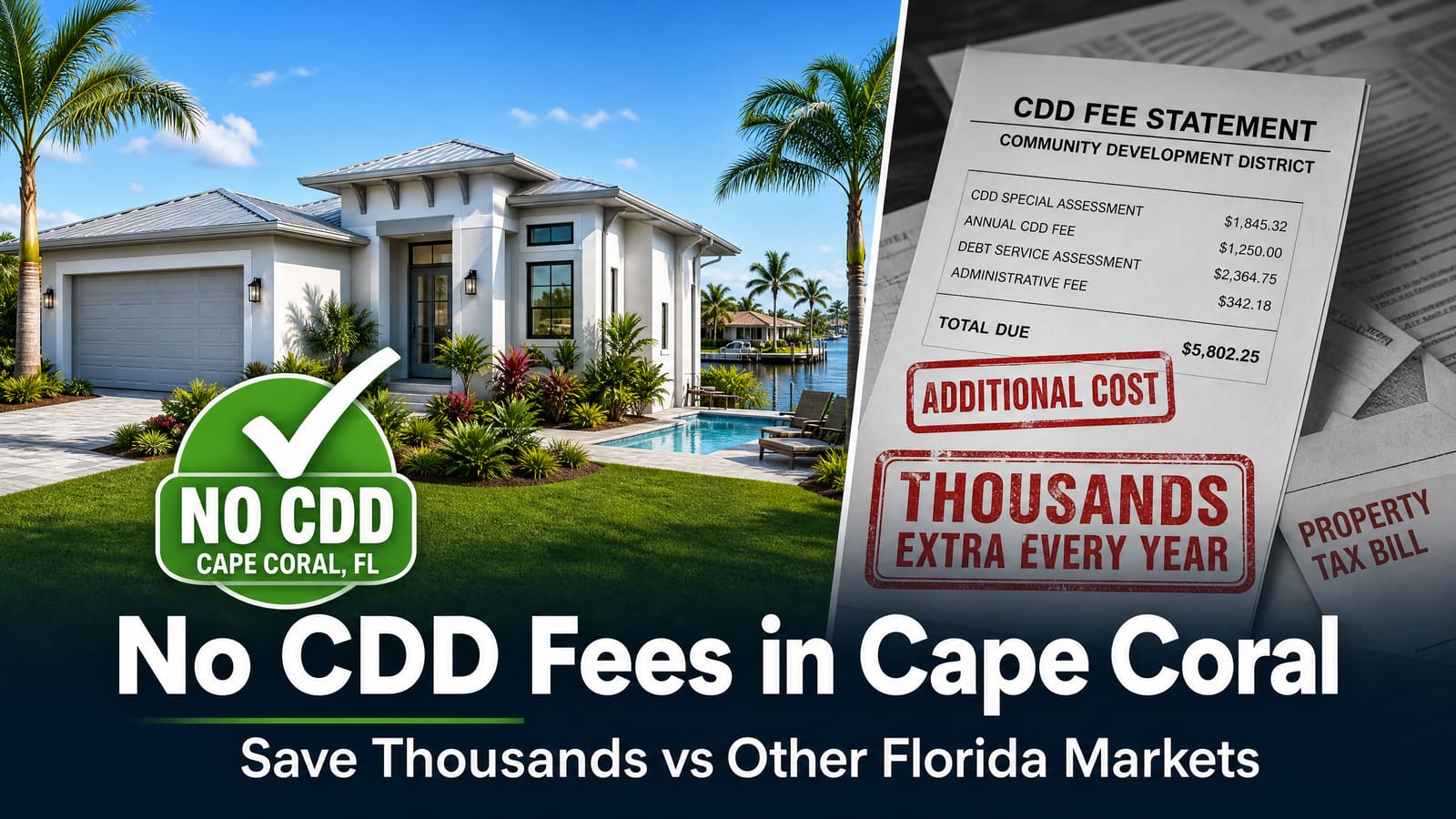
You found the home. Great price, brand new, checks every box. Then you pull the property tax record and there's a line item you've never heard of sitting under the taxes — "CDD assessment," a few thousand dollars a year — and nobody at the model home mentioned it once.
Welcome to how a lot of Florida's shiny master-planned communities actually price. The house is the sticker. The CDD is the fine print. And it can quietly add tens of thousands of dollars to what you pay over the years you own the place.
Here's the good news, and it's the entire reason this post exists: in Cape Coral, on the vast majority of new-construction homes, that line item doesn't exist. No CDD. No mandatory HOA. Let me show you exactly what that's worth in real dollars — because most out-of-state buyers have no idea what they're not paying here.
What a CDD Actually Is (and Why It's on Your Tax Bill Forever)
Let's demystify the thing. A CDD — Community Development District — is a special taxing district Florida lets a developer set up to pay for a new community's infrastructure: the roads, the water and sewer lines, the amenity center, the gated entry, the landscaped boulevards.
Here's the catch. The developer doesn't eat that cost. They float bonds to build all of it, and then you pay those bonds back through an annual assessment tacked onto your property tax bill. It comes in two pieces: a debt-service portion that pays off the construction bonds — usually running 20 to 30 years — and an operations-and-maintenance portion that keeps the amenities running and never goes away.
So when a builder in a master-planned community quotes you a monthly payment, ask the question nobody volunteers: what's the CDD? Because that number is riding shotgun on your mortgage for decades.
What That Line Item Costs in the Communities You're Also Considering
If you're shopping Florida new construction, you're probably also looking at the big master-planned names — and a lot of them carry a CDD. It's not a scandal; it's just the model. Places like Babcock Ranch and Ave Maria, and master-planned communities up in Wesley Chapel, out in Port St Lucie, and around Sarasota, commonly fund their infrastructure exactly this way.
CDD assessments vary by community, but they routinely land in the $1,000 to $3,000+ a year range, and the debt-service piece sticks around for 20 to 30 years. Stack a mandatory HOA on top — which most of those communities also have — and buyers in master-planned Florida frequently hand over $200 to $500 a month in combined CDD and HOA before they've paid a dime of principal.
Now run that forward. Take the middle of the road — say $300 a month in combined CDD and HOA. That's $3,600 a year. Over a 30-year ownership, north of $100,000. On a home you already bought. That's not a typo, and it's not an edge case — it's the standard deal in a huge share of Florida's new-construction communities.
Why Cape Coral Doesn't Have One
So why does Cape Coral get to skip all that? History.
Cape Coral wasn't master-planned by a modern developer floating amenity bonds. It was platted back in the late 1950s by the Rosen brothers' Gulf American operation as a giant grid of individual, pre-platted lots — hundreds of thousands of them. There was no single developer building one gated village with a shared amenity campus to bond and bill you for. The lots were sold off one at a time, and builders have been filling them in ever since.
That origin story is why, decades later, you can buy a brand-new home in Cape Coral on a pre-platted lot with no CDD and no mandatory HOA. You're not buying into a district. You're buying a house on a lot in a city. The infrastructure's already there, paid for the ordinary way, through your regular city and county taxes — not a special bond assessment layered on top.
That's the local fact no national real-estate site will ever explain to you, and it's worth real money.
The Honest Trade-Off (Because There Is One)
Now let me not sell you mush — no HOA and no CDD isn't a pure freebie, and you should know the trade before you celebrate.
That $300 a month buys something in a master-planned community: the resort pool, the fitness center, the gated entry, the manicured common areas, sometimes lawn care and cable. Cape Coral's no-fee lots don't come with a shared amenity campus. Want a pool? You build your own in the backyard. Want your lawn done? You hire it or you do it. And with no deed restrictions, your neighbor has more freedom with their property than an HOA community would allow — which most people love and a few people don't.
Here's the skinny: for the overwhelming majority of buyers I talk to, that trade is a landslide. You'd rather keep the $300 a month, own your own pool, and answer to nobody than pay a district for a shared pool you'll use twice a year. But if your heart is set on gated, amenity-rich, HOA-manicured living, that's a real thing Cape Coral's pre-platted lots don't hand you — and that's an honest reason some buyers choose a CDD community on purpose.
Listen Up: How to Actually Use This When You Shop
Here's how to make this pay off instead of just nodding along.
When you compare a Cape Coral new build against a home in a master-planned community somewhere else, do not compare the two sticker prices. Pull the other community's CDD assessment and HOA dues, add them up, and add that monthly number to their price before you decide which home is "cheaper." Half the time, a Cape Coral home that looked a touch more expensive is thousands a year cheaper to actually own.
And it's not just cash flow — it's buying power. That $300 a month you're not spending on fees is $300 a month a lender can count toward the house instead. No-CDD, no-HOA can literally qualify you for more home, or a lower total payment on the same home. Bring that up with your lender; most buyers never connect the dots.
Key Takeaways
- A CDD (Community Development District) assessment funds a master-planned community's infrastructure through bonds you repay on your tax bill — commonly $1,000–$3,000+ a year for 20–30 years.
- The vast majority of new-construction homes in Cape Coral have no CDD and no mandatory HOA — a direct result of the city being platted in the 1950s as pre-platted lots, not a modern master-planned development.
- Combined CDD + HOA in master-planned Florida often runs $200–$500/month — north of $100,000 over a 30-year ownership on a home you already bought.
- The trade-off is real: no shared pool, gate, or lawn service, and no deed restrictions. For most buyers that's a win; for amenity-and-gate seekers it's a genuine reason to look elsewhere.
See What's Actually Available
The market changes every week as homes list and close. See it live, filtered by what actually matters to you:
- Every active new build in Cape Coral
- New construction under $400K
- Compare every builder in one place
- Pool homes (build your own — no shared-amenity fee needed)
Not sure how a no-CDD Cape Coral home really compares to that master-planned community you toured somewhere else? That's the whole reason we're here.
If you need help buying in Cape Coral, call us at (239) 422-7459 and we'll do the real math — sticker plus fees, side by side — so you see what each home actually costs to own.
Frequently Asked Questions
Does Cape Coral have CDD fees?
For the vast majority of new-construction homes, no. Cape Coral was platted in the 1950s as a grid of individual pre-platted lots rather than a modern master-planned development, so most homes carry no Community Development District assessment. Always confirm on the specific property's tax record, but a no-CDD result is the norm here — unlike many master-planned communities elsewhere in Florida.
What is a CDD fee and how much does it cost?
A CDD (Community Development District) assessment repays the bonds a developer used to build a community's roads, utilities, and amenities. It appears on your annual property tax bill and commonly runs $1,000 to $3,000 or more per year, with the debt-service portion lasting 20 to 30 years. An operations-and-maintenance portion continues indefinitely.
Does Cape Coral have HOA fees?
Most new-construction homes on Cape Coral's pre-platted lots have no mandatory HOA. Some specific newer subdivisions or condo/villa products may, so confirm per property — but the standard single-family new build in the Cape is HOA-free, which is unusual for Florida new construction and saves buyers hundreds a month versus master-planned communities.
How much can no CDD and no HOA save me in Cape Coral?
In master-planned Florida communities, combined CDD and HOA commonly runs $200–$500 a month. At $300 a month, that's $3,600 a year and over $100,000 across a 30-year ownership. Skipping it in Cape Coral is real money you keep — and money a lender can count toward qualifying you for the home instead.
What's the downside of no HOA or CDD?
No shared amenities (resort pool, fitness center, gated entry), no lawn or common-area maintenance included, and no deed restrictions governing what neighbors do with their property. Most buyers prefer the freedom and the savings; buyers who specifically want gated, amenity-rich, uniformly maintained neighborhoods may prefer a community that has an HOA and CDD.
See every new construction home in Cape Coral — live
Straight off the Southwest Florida MLS, refreshed every 15 minutes, with the flood zone, utilities and builder on every card.
Keep reading
All guides
Buyer Guides
No HOA, No CDD in Cape Coral: The Freedom (and the $200–$500 a Month) Most Florida Buyers Never Get
6 min read
Buyer Guides
City Water & Sewer vs Septic in Cape Coral New Construction: Which Areas Have What (2026)
8 min read
Buyer Guides
Moving from Miami to Cape Coral: Why East Coast Buyers Are Trading the Condo for a Canal (2026)
7 min read