
No HOA, No CDD in Cape Coral: The Freedom (and the $200–$500 a Month) Most Florida Buyers Never Get
John Garuti Updated Aug 3, 2026 6 min read
Florida had to legislate that you're allowed to park your truck at your own house. On most Cape Coral new builds, none of that ever applies — no board, no fines, no CDD. Here's what that's worth.

In 2024, the Florida Legislature sat down and passed an actual law to stop homeowners associations from fining people for leaving a trash can at the curb too long. Same law: your HOA can't fine you for a vegetable garden, can't make you take the holiday lights down on their schedule, and — my personal favorite — can't stop you from parking your own pickup truck in your own driveway.
Read that back. The state had to legislate that you're allowed to park your truck at your house.
That's the world a lot of Florida buyers are signing up for without reading the fine print — a board of neighbors with a rulebook, a fine schedule, and your paint color on the agenda. And here's what almost nobody tells the out-of-state buyer scrolling listings at midnight: on the vast majority of new-construction homes in Cape Coral, none of that exists. No HOA telling you what to do. No CDD riding shotgun on your tax bill. Just you, your lot, and your house. Let me show you what that's actually worth — in rules and in dollars.
What You're Really Buying When You Buy "Under an HOA"
Let's be honest about what an HOA is, because the brochure won't. It's a private government for your street. It has the power to tell you what you can park, what you can plant, what color you can paint, whether you can rent your place out, and how much you owe every month whether you use the pool or not. Miss the memo and you get a fine. Ignore the fine and, in Florida, an association can eventually put a lien on your home.
You don't have to take my word for how far that goes — just look at what Florida had to outlaw in HB 1203, the 2024 overhaul of the state's HOA law. The Legislature stepped in to block associations from fining owners over garbage cans, holiday decorations, and vegetable gardens, and from banning pickup trucks in driveways (that one applies going forward, to newer communities). When lawmakers have to write "you may keep a tomato plant" into the statutes, that tells you exactly how tight the leash had gotten.
None of that is a fight you'll ever have in most of Cape Coral. There's no board, no covenant, no architectural-review committee deciding your shutters are the wrong shade of gray.
The Number Nobody Puts on the Model-Home Whiteboard
Now the money. Because freedom is nice, but this part is where it gets real.
I sell homes in Babcock Ranch, a master-planned community about 40 minutes up the road — beautiful place, and yes, it has an HOA and a CDD, and I'll happily tell any buyer exactly what those cost. In fact, we publish the full Babcock fee table, neighborhood by neighborhood, on our Babcock site. So this isn't me trashing master-planned living. It's me handing you the receipts.
| SW Florida community | HOA | CDD (on your tax bill) | Roughly per year |
|---|---|---|---|
| Babcock Ranch — Webb's Reserve (bundled golf) | $662–$1,000/mo | $1,680–$2,750/yr | $9,600–$13,700 |
| Babcock Ranch — Verde | $362–$378/mo | $2,053–$2,755/yr | $6,400–$7,300 |
| Babcock Ranch — Sabal Glen at MidTown | ~$313/mo | $2,138–$2,511/yr | $5,900–$6,300 |
| Most new Cape Coral homes | $0 | $0 | $0 |
(Babcock figures are from the 2026 HOA sheets and BRCISD assessment schedule and change every year — current table here. The Cape Coral zero is the point.)
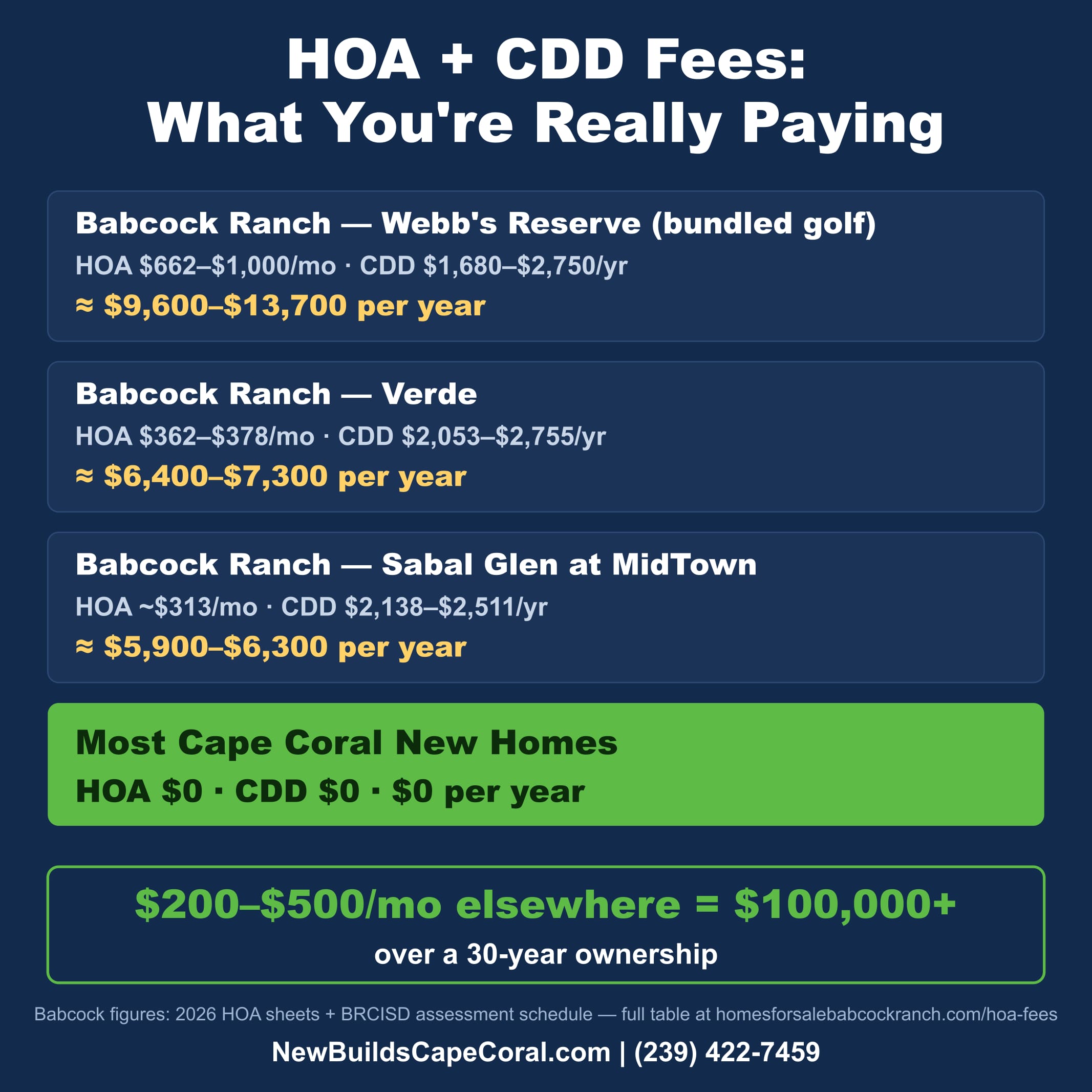
Across master-planned Florida, combined HOA and CDD commonly runs $200 to $500 a month. Call it $300. That's $3,600 a year. Over a 30-year hold, north of $100,000 — on a house you already bought, for a pool you might use twice a summer.
Here's the part your lender cares about: that $300 a month isn't just savings, it's buying power. Money you're not sending to an association is money a lender can count toward qualifying you. In a market where rates and prices already stretch a budget, skipping the fees can be the difference between the 3-bedroom and the 4-bedroom — or between qualifying and getting a "not quite."
Your House, Your Rules — Including Renting It Out
This is the one that matters most to the buyers I talk to, and it never makes the listing.
No HOA means no covenant capping how — or whether — you rent your place. Want to snowbird half the year and rent it the other half? Want to run it as a seasonal rental and let it help pay for itself? Want to hand it to your kid, park an RV beside it, build a screened lanai, or paint the front door a color that would give an architectural committee a stroke? In most of Cape Coral, that's your call, not a board's.
That freedom is a big reason investors and part-time Floridians zero in on the Cape. An HOA can impose minimum lease terms, rental caps, even waiting lists before you're allowed to rent at all. Buy a no-HOA Cape home and you skip that whole rulebook. (Cape Coral does have its own city ordinances — this isn't lawlessness — but that's a world away from a private board voting on your business.)
Listen Up: When an HOA Is Actually Worth It
I'm pro-buyer, not anti-HOA, so here's the straight talk.
An HOA and a CDD are buying you something: shared amenities, a gate, lawn and common-area upkeep, and a rulebook that keeps the guy next door from parking a boat on blocks in his front yard for three years. If you want the resort pool and the manicured, everybody-matches look — and you'd rather pay a fee than manage your own yard or worry about a messy neighbor — a master-planned community is a genuinely good fit, and I'll help you buy in one. That's literally part of what I do.
But if you'd rather keep the $300 a month, own your lot without a board, rent it when you want, and park whatever you drive in your own driveway — that's Cape Coral, and it's most of the new construction going up here. The trade-off is real. Just make it on purpose instead of finding out about the CDD line after you've fallen for the house.
Key Takeaways
- Florida's 2024 HOA law (HB 1203) had to specifically stop associations from fining owners over trash cans, holiday decorations, and vegetable gardens, and from banning pickup trucks in driveways — a good picture of how much control an HOA holds.
- Most new-construction homes in Cape Coral have no mandatory HOA and no CDD — a legacy of the city's 1950s pre-platted lot grid rather than modern master-planned development.
- Combined HOA + CDD in master-planned Florida commonly runs $200–$500/month — over $100,000 across a 30-year ownership — and that money also counts against your loan qualifying power.
- No HOA means no rental restrictions, no deed-restriction rulebook — a major draw for investors, snowbirds, and anyone who wants to actually use their property their way.
- The trade-off is real: no shared pool, gate, or lawn service, and no board keeping the neighborhood uniform. For most Cape buyers, keeping the money and the freedom wins.
See What's Actually Available
The market changes every week as homes list and close. See it live, filtered by what actually matters to you:
- Every active new build in Cape Coral
- New construction under $400K (stretch the budget further with no fees)
- Compare every builder in one place
- Pool homes — build your own, no shared-amenity fee required
Not sure whether that master-planned community you toured is really worth the monthly fee versus a no-HOA Cape home? That's the whole reason we're here — we'll run the real math, fees and all, side by side.
If you need help buying new construction in Cape Coral, call us at (239) 422-7459 and we'll tell you straight — what a no-HOA home really costs to own, and when a fee-based community is actually the better buy for you.
Frequently Asked Questions
Do new construction homes in Cape Coral have an HOA?
Most don't. The standard single-family new build on Cape Coral's pre-platted lots carries no mandatory HOA. Some specific newer subdivisions, gated enclaves, or villa/condo products do have one, so always confirm on the individual property — but HOA-free is the norm here, which is unusual for Florida new construction.
What's the difference between an HOA and a CDD?
An HOA (homeowners association) is a private organization that enforces community rules and collects monthly or quarterly dues for amenities and upkeep. A CDD (Community Development District) is a special taxing district that repays the bonds a developer used to build the community's infrastructure — it shows up on your property tax bill, often for 20–30 years. Master-planned communities frequently have both. Most Cape Coral homes have neither — we broke down the full CDD math in its own guide.
Can I rent out a home in Cape Coral if there's no HOA?
Yes. Without an HOA covenant, there's no association-imposed minimum lease term, rental cap, or approval process. You'll still follow Cape Coral's city ordinances and Florida law, but you won't answer to a private board about whether or how you rent — which is why the Cape is popular with investors and part-time residents.
How much does no HOA and no CDD actually save me?
In master-planned Florida, combined HOA and CDD commonly runs $200–$500 a month. At $300, that's $3,600 a year and over $100,000 across a 30-year ownership — money you keep, and money a lender can count toward qualifying you for the home instead.
Is there any downside to buying with no HOA?
Yes, and it's fair to weigh it. No HOA means no shared amenities (resort pool, gym, gated entry), no included lawn or common-area maintenance, and no rules keeping every yard uniform — so a neighbor can do things with their property you might not love. Buyers who specifically want amenities and a tightly managed look may prefer a community that has an HOA. Most Cape buyers prefer the freedom and the savings.
See every new construction home in Cape Coral — live
Straight off the Southwest Florida MLS, refreshed every 15 minutes, with the flood zone, utilities and builder on every card.
Keep reading
All guides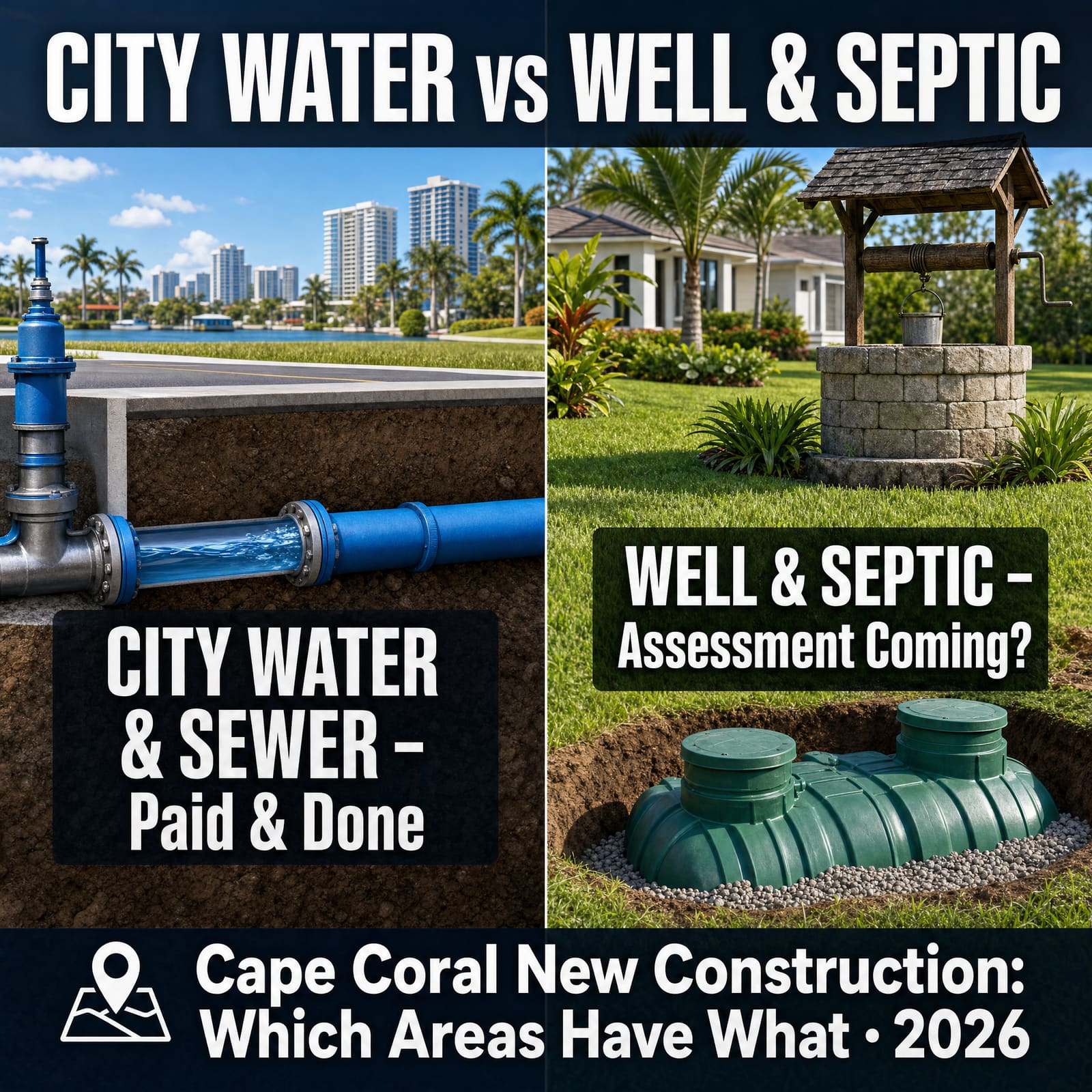
Buyer Guides
City Water & Sewer vs Septic in Cape Coral New Construction: Which Areas Have What (2026)
8 min read
Buyer Guides
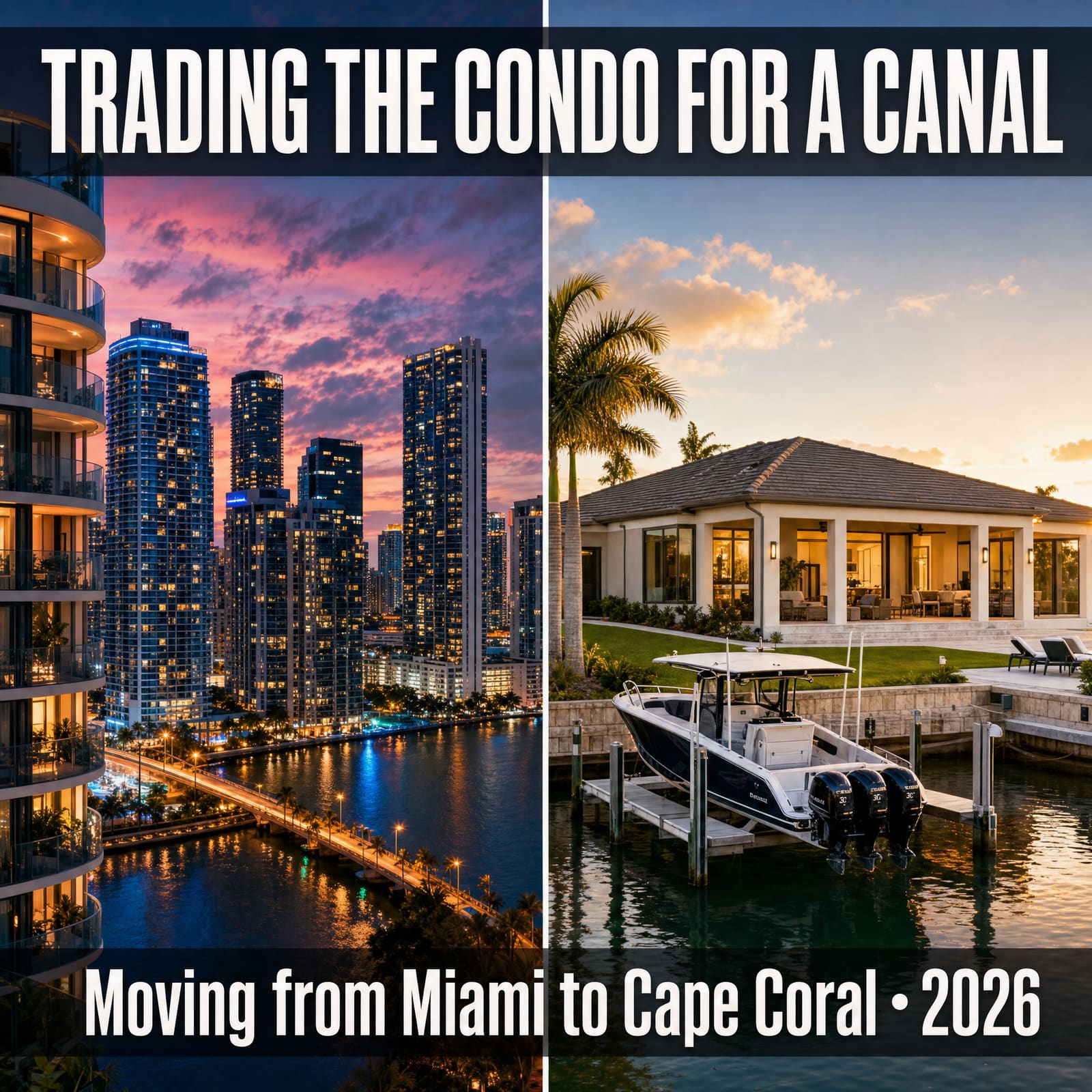
Moving from Miami to Cape Coral: Why East Coast Buyers Are Trading the Condo for a Canal (2026)
7 min read

Buyer Guides
Is Cape Coral a Good Place to Live? An Honest 2026 Review for Out-of-State Buyers
6 min read