
Is Cape Coral a Good Place to Live? An Honest 2026 Review for Out-of-State Buyers
John Garuti Updated Jul 28, 2026 6 min read
Somebody warned you it's a giant grid with no downtown. Somebody else called it heaven on a canal. Both are right — here's how to figure out which buyer you are before you sign.

Somebody in your life has already warned you about Cape Coral. "It's a giant grid." "There's no downtown." "It's hot as blazes in August." And somebody else has told you it's heaven on a canal. So which is it?
Both. That's the honest answer, and it's the one you won't get from a glossy relocation brochure. Cape Coral is a genuinely great place to live for a specific kind of person — and a mild letdown for a different kind. The trick is figuring out which one you are before you've signed for a house two states away. So let's do the thing nobody selling you a home wants to do: run through the real pros and the real cons, no sugar.
First, What Cape Coral Actually Is
Cape Coral isn't a quaint old Florida town that grew up over a century. It's a planned city, carved out of the mangroves starting in 1957, and it's big — roughly 120 square miles, the second-largest city in Florida by land area, home to somewhere north of 200,000 people. It was built on one wild idea: dig 400 miles of canals — more than any city on the planet — and give regular people a saltwater backyard.
That origin story explains almost everything you'll love and everything you'll grumble about. The water is spectacular. The layout is a sprawling grid built for cars, not strolls. Keep that in mind as we go, because nearly every pro and con below traces straight back to it.
The Case For: Why People Fall Hard for the Cape
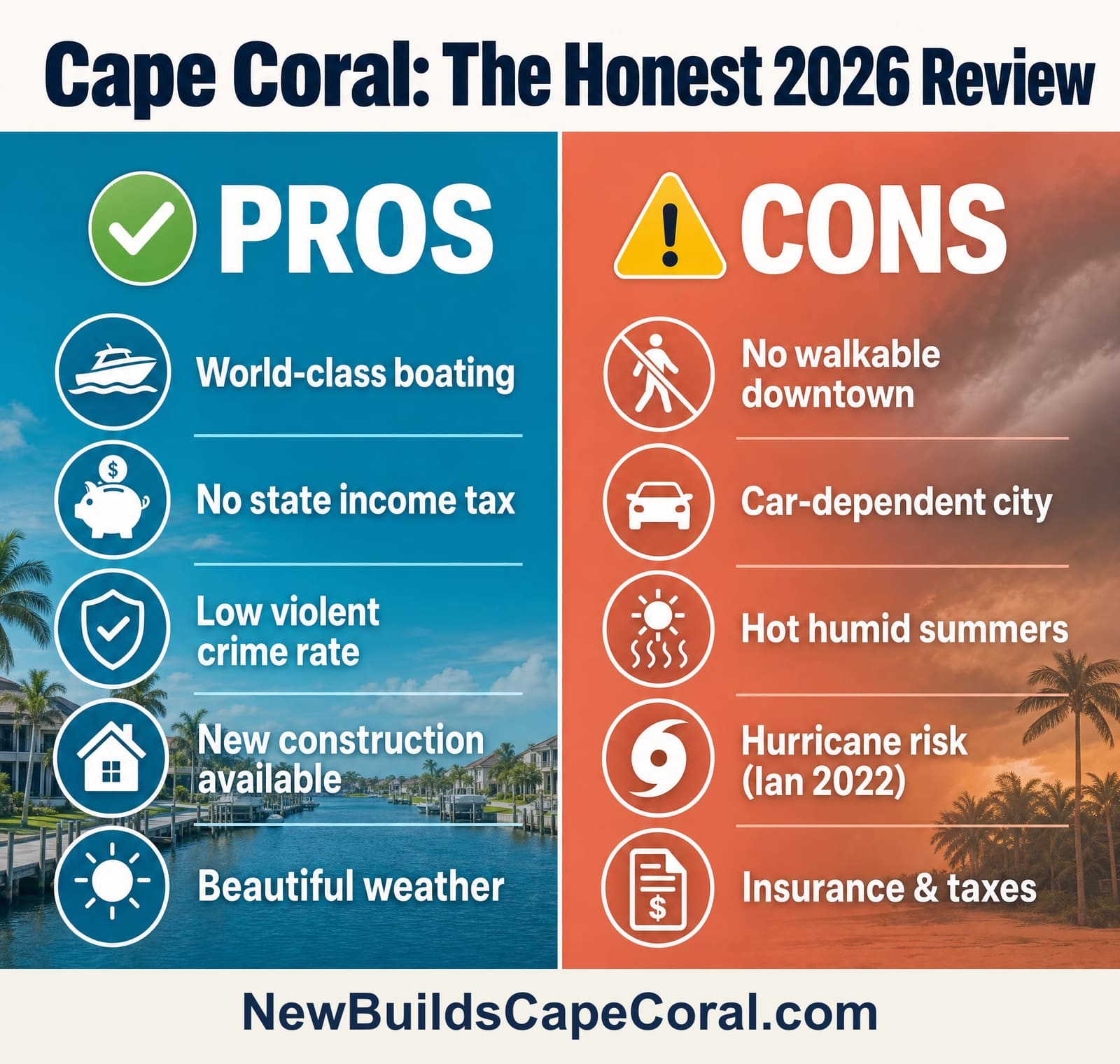
The boating life is the real deal. This is the headline. If your idea of a good Saturday is untying from your own dock and running out to the Gulf, few places in America deliver it at this price. Homes on the water here would cost two or three times as much on either coast up north.
No state income tax. Florida doesn't take a cut of your paycheck, your pension, or your Social Security. For a household relocating from New York, New Jersey, or Illinois, that's not a rounding error — it's often thousands of dollars a year that stays in your pocket. Combined with new-construction prices that still start below $300K, it's why the mortgage-vs-rent math flips so many out-of-state buyers.
It's genuinely safe. Cape Coral consistently posts a violent-crime rate roughly half the national average — it lands on "safest large cities in Florida" lists year after year. For families and retirees, that's not a footnote; it's the whole point.
The weather does what you moved here for. Locals will tell you the sun shines something like 355 days a year. Winters are the payoff — think 70s and blue skies in January while your old street is buried in salt and slush.
Space and new homes. Unlike the built-out coast, the Cape still has room, and builders are still building. You can buy a brand-new home — no 1978 wiring, no popcorn ceilings, hurricane-code windows standard — on a full lot, which is a tough combo to find in most of coastal Florida.
The Case Against: The Stuff You Should Know Before You Sign
Now the honest half. None of these are dealbreakers for the right buyer — but you deserve to hear them straight.
There's no real downtown. If you're picturing a walkable main street with a coffee shop, a bookstore, and a wine bar you stroll to on a Friday night, adjust the picture. The Cape's walkability score sits around 17 out of 100. There are pockets of energy — the Yacht Club area, some newer development — but a European-style town center this is not.
You will drive. A lot. This is a car city, by design. "You really can't just walk to the grocery store" is the single most common thing new arrivals say. On a 120-square-mile grid, a run of errands means real windshield time, and a 20-minute trip can stretch toward an hour at season's peak when the snowbirds are all on the road.
Summer is a heavyweight. June through September is hot and humid, with afternoon thunderstorms you can set your watch to. The flip side of those low winter bills: summer electric can climb into the $250–$420 a month zone when the AC never rests. It's the tax you pay for those glorious Januaries.
Hurricanes are real, and Ian is recent. Hurricane Ian hit this region hard in September 2022, and pretending otherwise would be dishonest. The upside for a new-construction buyer: today's homes are built to a tough Florida wind code, and — this is the part out-of-staters miss — being in a flood zone here doesn't mean high risk on a properly elevated new build. (We wrote a whole guide on that; it's worth your ten minutes.)
Insurance and taxes aren't nothing. No income tax is great, but you'll feel it elsewhere: property taxes run somewhere around 17–20 mills combined, and homeowners plus flood insurance is a real line item, especially on the water. The homestead exemption helps a lot if this is your primary home — budget for the whole picture, not just the mortgage.
Listen Up: Who Should Actually Buy Here
Here's my blunt take after selling in this market.
You'll love Cape Coral if you want space, sunshine, safety, and — above all — the water, and you're fine trading a walkable downtown for a big new home you drive around from. Boaters, remote workers who don't need an office district, families who want a safe yard, and retirees stretching a fixed income with no state income tax: this city was practically built for you.
You might not love it if your dream is car-free urban living, a vibrant nightlife-and-restaurant scene within walking distance, or four real seasons. That person tends to be happier in a denser coastal town — and honestly, I'd rather tell you that now than sell you a house you regret. That's not a great way to run a business, but it's the only way I know how to.
For most out-of-state buyers I meet, the pros aren't close to the cons. But "most" isn't "all" — and only you know which list is yours.
Key Takeaways
- Cape Coral is a planned canal city — ~120 sq mi, Florida's 2nd-largest by land area, 400+ miles of canals, and 200,000+ residents.
- Biggest pros: world-class boating at a fraction of coastal-north prices, no state income tax, a violent-crime rate about half the national average, and abundant new construction.
- Biggest cons: no true walkable downtown (walk score ~17), heavy car dependence, hot/humid summers with higher AC bills, and real hurricane/insurance considerations post-Ian.
- New-construction homes are built to modern Florida wind code, and a flood-zone address on a properly elevated new build is not the risk out-of-staters assume.
- Best fit: boaters, families, remote workers, and retirees who value space and sunshine over urban walkability.
See What's Actually Available
The best way to answer "is this the place for me?" is to look at what your money actually buys here — live, this week:
- Every active new build in Cape Coral
- New construction under $400K
- Canal & gulf-access new construction
- New-construction pool homes
Still weighing whether Cape Coral fits your life, your budget, and your must-haves? That's exactly the conversation we have all day.
If you need help buying new construction in Cape Coral, call us at (239) 422-7459 and we'll give you the honest version — the good, the annoying, and whether this is really your spot — before you ever get on a plane.
Frequently Asked Questions
Is Cape Coral a good place to live in 2026?
For the right buyer, yes — it offers exceptional boating and waterfront access, no state income tax, a low violent-crime rate, and plenty of new construction at prices well below the northern coasts. The honest trade-offs are the lack of a walkable downtown, heavy reliance on a car, hot summers, and hurricane/insurance realities. Boaters, families, and retirees tend to love it; buyers set on car-free urban living usually don't.
Is Cape Coral safe?
Yes, notably so. Cape Coral consistently reports a violent-crime rate around half the national average and regularly appears on lists of the safest large cities in Florida — one of the top reasons families and retirees choose it.
Does Cape Coral have a downtown?
Not in the traditional, walkable sense. The city was planned around a car-oriented grid, and its walkability score sits near 17 out of 100. There are lively pockets — the Yacht Club area and newer developments among them — but if a strollable main-street downtown is a must-have, temper your expectations.
What are the downsides of living in Cape Coral?
The main ones: you'll need a car for nearly everything, there's no classic walkable downtown, summers are hot and humid (with higher AC bills), and hurricanes and insurance are genuine considerations in Southwest Florida. New construction built to current code, plus the homestead exemption, softens several of these.
How much does it cost to live in Cape Coral?
Cost of living lands right around the national average, and Florida's lack of a state income tax is a meaningful plus for relocating households. Balance that against property taxes (roughly 17–20 mills combined), homeowners and flood insurance, and summer electric bills. New-construction prices still start below $300K, which keeps the overall math attractive for many out-of-state buyers.
Did Hurricane Ian ruin Cape Coral?
No. Ian struck the region hard in September 2022, and the area has been rebuilding and growing since. For new-construction buyers, modern homes are built to a strict Florida wind code, and being in a flood zone on a properly elevated new home doesn't carry the risk many out-of-state buyers assume.
See every new construction home in Cape Coral — live
Straight off the Southwest Florida MLS, refreshed every 15 minutes, with the flood zone, utilities and builder on every card.
Keep reading
All guides
Buyer Guides
No HOA, No CDD in Cape Coral: The Freedom (and the $200–$500 a Month) Most Florida Buyers Never Get
6 min read
Buyer Guides
City Water & Sewer vs Septic in Cape Coral New Construction: Which Areas Have What (2026)
8 min read
Buyer Guides
Moving from Miami to Cape Coral: Why East Coast Buyers Are Trading the Condo for a Canal (2026)
7 min read