
City Water & Sewer vs Septic in Cape Coral New Construction: Which Areas Have What (2026)
John Garuti Updated Aug 1, 2026 8 min read
Two identical new builds — one $12,000+ more expensive than the other, and nothing in the photos will tell you which. The difference is underground, and it's called the UEP assessment.
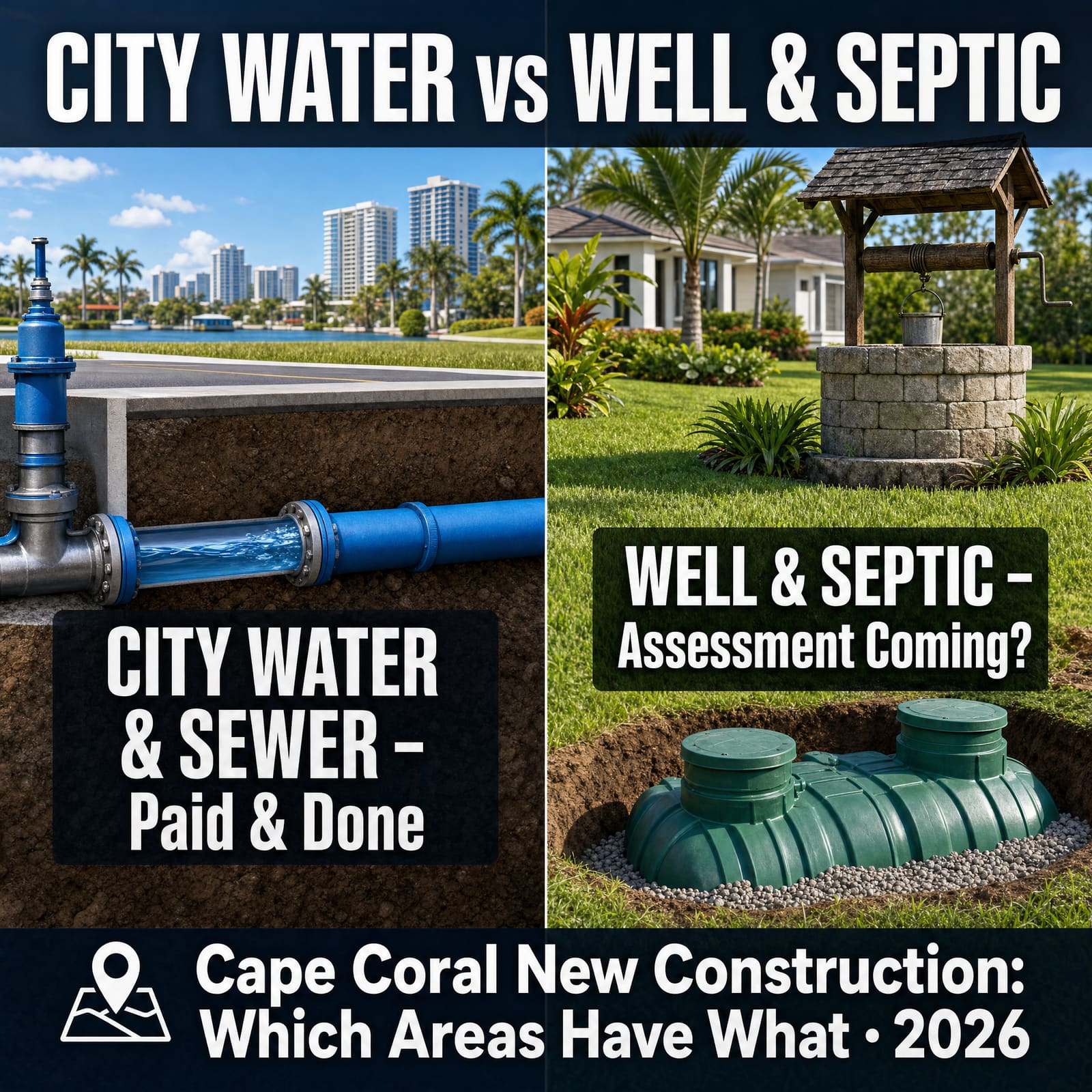
Two brand-new houses. Same builder, same floor plan, same granite, same price on the listing. One of them is going to cost you twelve thousand dollars more than the other, and nothing on the MLS photos will tell you which one.
The difference is underground.
One of those homes is hooked to Cape Coral city water and sewer, paid and done. The other is sitting on a well and a septic tank in an area the city hasn't finished converting yet — which means a utility assessment is coming, and the bill lands on whoever owns the house when it does. That's you, if you don't ask the right question before you sign.
So let's make sure you ask it. By the end of this you'll read a Cape Coral listing's utility fields the way somebody who sells here reads them — and you'll know how to check the real number before it checks you.
Cape Coral Runs Its Own Pipes — and That's the Whole Story
Here's the thing most out-of-state buyers don't realize: Cape Coral is a city utility, not a county one. The city owns and runs the water, the sewer, and a separate irrigation system. That sounds like plumbing trivia until you understand how the Cape actually got built.
Cape Coral started life in the 1960s as a giant grid of home sites carved out of low, rural ground — wells for drinking water, septic tanks for waste, and not much else. Then it grew into Florida's third-largest city by land area, north of 200,000 people. All those septic tanks sitting over the aquifer and draining toward 400 miles of canals became a problem the city has spent decades fixing, one section at a time, with a program called the Utilities Extension Project — the UEP.
The UEP is the city marching north across the Cape, ripping out well-and-septic and putting in city water, sewer, and irrigation. The southern and central parts of the Cape? Long done — city utilities, connected, paid. The north and northwest — where the most affordable new construction is going up right now — is still mid-conversion. And "mid-conversion" is a phrase with a dollar sign attached.
The Assessment: The Twelve-Thousand-Dollar Question Nobody Tells You to Ask
When the UEP brings city utilities to your street, the city doesn't eat the cost. It assesses the property owners on that street to pay for the pipe in front of their lot. That's the assessment. And it's real money.
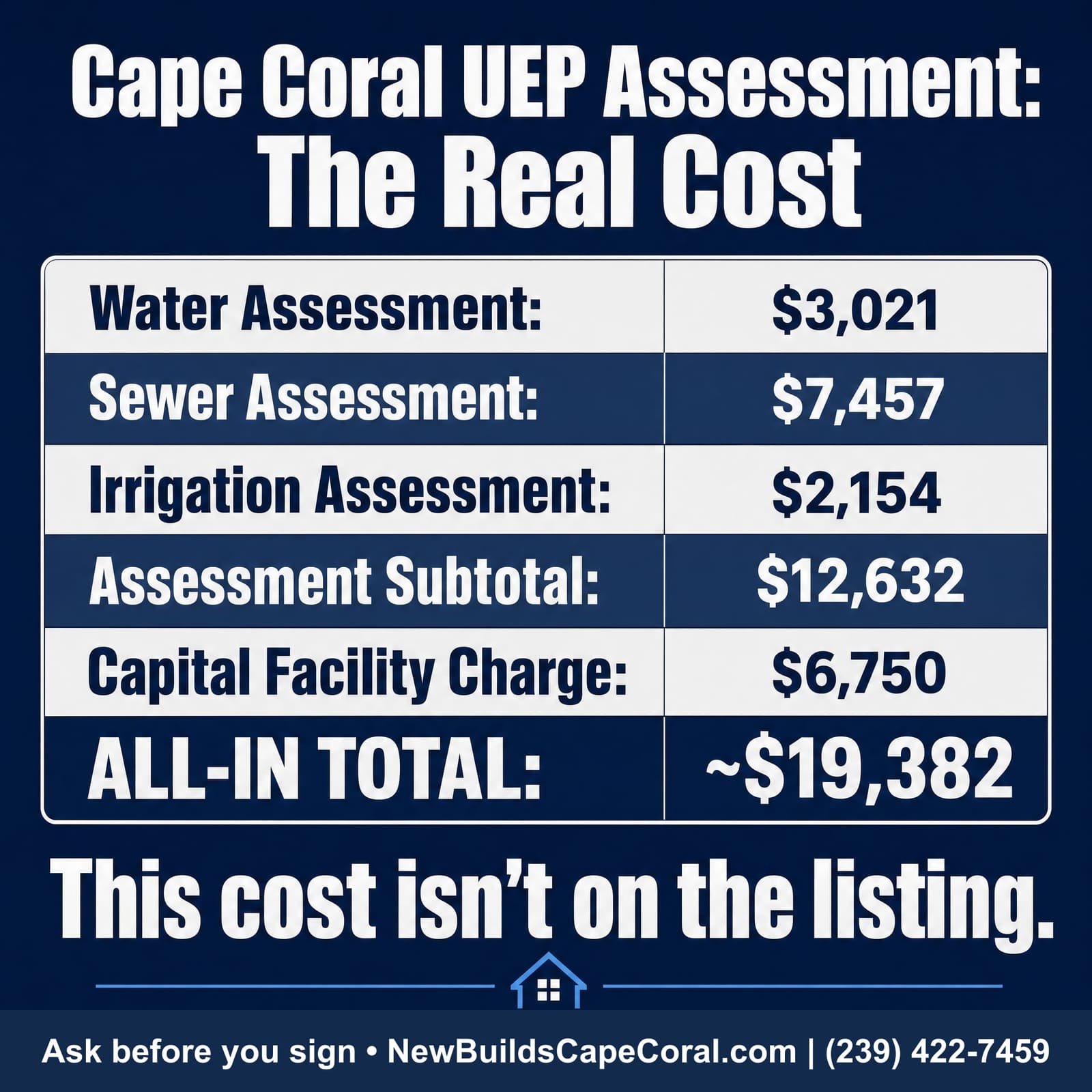
Look at North 2 — an area the city has already finished. Here's what the city actually charged per standard lot, straight off Cape Coral's own published schedule:
| North 2 — city's published assessment (per equivalent lot) | Amount |
|---|---|
| Water assessment | $3,021 |
| Sewer assessment | $7,457 |
| Irrigation assessment | $2,154 |
| Assessment subtotal | $12,632 |
| Capital facility expansion charge (water + sewer + irrigation) | $6,750 |
| All-in, before your own connection/plumbing | ~$19,382 |
Read that bottom row again. That's not a typo and it's not the sale price. That's the utility tab on a single lot in a North area — and it exists whether the house on it is forty years old or built last month. The assessment can be paid in one lump at closing or financed over roughly twenty years on your property-tax bill, but somebody pays it. The only question is whether that somebody already did.
Here's the blunt version: an assessment that's already been paid is money in your pocket. An assessment that's still coming is a second price tag stapled to the house that isn't printed anywhere on the listing. Two identical new builds can be $12,000+ apart in true cost for exactly this reason — and the cheaper-looking one is often the one with the bill still coming.
Where You Actually Are on the Map
So which is it for the home you're eyeing? It comes down to where the UEP has already been. Rough lay of the land for 2026:
The south and central Cape — the established grid — is on city water and sewer, converted long ago. Assessments there are ancient history.
The north is where the action is. North 2 is built out and connected. North 1 — split into an East and a West half at Del Prado Boulevard — is in active construction, with the West side targeted to wrap in 2026 and the East side starting up. North 3 is in design. North 5 and North 6 are still in study, meaning conversion is years out and those homes are firmly on well and septic for now.
Notice what that means for the bargain-hunter. The most affordable new construction in the Cape is going up in the northwest — a lot of it in ZIP 33993 — precisely because that's where the raw land still is. Which is also precisely where the assessments are either freshly landed or still on the way. Cheap lot, great house, and a five-figure utility surprise hiding in the timing. That's the trap. Now you can see it coming.
Well and Septic Isn't a Dealbreaker — Going in Blind Is
Let me be fair here, because I'm pro-buyer, not anti-septic. Plenty of good new homes in the Cape sit on well and septic today and function just fine. A modern septic system on a properly graded new-construction lot is not the horror story people from sewer-only states imagine. Well water in the Cape is hard and usually wants a softener, but it's not undrinkable, and you're not paying a monthly water bill on irrigation you pull from your own well.
The problem was never the septic tank. The problem is buying a well-and-septic home in a North area without knowing an assessment is scheduled — and then getting the notice from the city eighteen months after you close. That's the phone call I don't want you making.
So do this before you fall for a house: get the exact address and check its UEP status. Ask the builder point-blank — "Is this lot on city water and sewer, or well and septic? If it's on septic, what UEP area is it in, and has the assessment been levied or is it still coming?" A straight builder answers straight. A builder who gets vague on that question just told you the answer.
Listen Up: How to Use This When You Shop
Here's how you turn all of this into leverage instead of a landmine.
First, treat "utility type" as a hard field, same as price and flood zone — not an afterthought. Before you tour, narrow your search to the areas and price bands that fit — you can even filter this site to city-water-and-sewer new construction — then get the utility status on your short list. In the established south-central Cape you're almost always on paid city utilities. Up north, assume nothing.
Second, when a home is on well and septic in a North area, find out whether the assessment is paid, pending, or years away — and then use it. A pending assessment is a real, documented cost. That's a negotiation chip. On the right deal you can ask the seller or builder to pay it, or credit it, or knock it off the price. Buyers who know the number negotiate with it. Buyers who don't, inherit it.
And whatever you do, don't compare two Cape Coral new builds on sticker price alone. Put the utility status next to each one first. The house that looks $12,000 cheaper sometimes isn't cheaper at all — it just hasn't handed you the second bill yet.
Key Takeaways
- Cape Coral runs its own city water, sewer, and irrigation — and has spent decades converting the Cape off well and septic through the Utilities Extension Project (UEP), section by section, north across the city.
- The south and central Cape are on paid city utilities. The north/northwest — where the most affordable new construction is — is still mid-conversion, so utility status varies lot by lot.
- Converting a lot triggers an assessment. Cape Coral's published North 2 figures: $12,632 in water/sewer/irrigation assessment plus a $6,750 capital facility charge — roughly $19,000 all-in on a single lot. It can be paid at closing or financed ~20 years on the tax bill.
- An already-paid assessment adds value; a pending one is a five-figure cost that isn't on the listing. Two identical new builds can be $12,000+ apart in true cost because of it.
- UEP status by area (2026): North 2 complete; North 1 (split at Del Prado Blvd) in construction; North 3 in design; North 5 & 6 in study. Much of the affordable new construction is in ZIP 33993.
- Ask the builder directly whether a lot is on city utilities or well/septic, and whether any assessment is paid or pending — then use a pending assessment as a negotiation chip.
See What's Actually Available
The market shifts every week as homes list and close. Here's how to start narrowing — then let us confirm the utility status on anything you like:
- ⭐ Filter to city water & sewer new construction
- Every active new build in Cape Coral
- New construction in NW Cape (ZIP 33993 — the affordable, assessment-sensitive area)
- New construction under $400K
- Canal & Gulf-access new construction
Not sure whether the home you love comes with paid city utilities or a $12,000 assessment still on the way? That's the whole reason we're here — and it's the difference between the real price and the sticker price.
If you need help buying new construction in Cape Coral, call us at (239) 422-7459 and we'll tell you straight — city or septic, assessment paid or pending — before you sign anything.
Frequently Asked Questions
Does new construction in Cape Coral come with city water and sewer?
It depends entirely on where the home sits. In the established south and central Cape, new construction connects to city water and sewer that's already in and paid for. In the north and northwest — where a lot of the newer, more affordable homes are being built — many lots are still on well and septic, with the city's Utilities Extension Project (UEP) converting them in phases. Always confirm the specific address.
What is the Cape Coral UEP assessment and how much is it?
The Utilities Extension Project (UEP) is the city's program to bring city water, sewer, and irrigation to areas still on well and septic. When it reaches your street, the city assesses the property owner to pay for it. In the completed North 2 area, the city's published charges were $12,632 in water/sewer/irrigation assessment plus a $6,750 capital facility expansion charge — roughly $19,000 per lot. Amounts vary by area, and the charge can be paid upfront or financed over about 20 years on your property-tax bill.
Who pays the assessment — the builder or me?
Whoever owns the property when the assessment is levied. On new construction, this is a contract-and-timing question you need answered in writing before you sign. If the assessment is already paid, it's built into the value. If it's pending, it becomes your cost unless you negotiate for the seller or builder to cover or credit it — which is exactly why you ask early.
Which parts of Cape Coral are still on well and septic?
Broadly, the northern sections. As of 2026, North 2 is converted; North 1 (split East/West at Del Prado Boulevard) is in active construction; North 3 is in design; and North 5 and North 6 are still in study, meaning those areas remain on well and septic for now. Much of the affordable new construction going up in ZIP 33993 falls into these northern areas — great value, but check utility status carefully.
Is a home on well and septic in Cape Coral a bad buy?
Not at all. A modern septic system on a properly graded new-construction lot works fine, and well water simply means adding a softener for the hardness. The real risk isn't the septic tank — it's buying in a North area without knowing an assessment is scheduled and getting surprised by a five-figure bill after closing. Know the status going in and it's just another line item, not a landmine.
How do I find out a specific home's utility status and assessment?
Ask the builder or your agent for the exact UEP status on that address — is it city water/sewer or well/septic, and has the assessment been levied or is it still coming? We do this for buyers all day and can pull it on any home you're considering before you tour or write an offer.
See every new construction home in Cape Coral — live
Straight off the Southwest Florida MLS, refreshed every 15 minutes, with the flood zone, utilities and builder on every card.
Keep reading
All guides
Buyer Guides
No HOA, No CDD in Cape Coral: The Freedom (and the $200–$500 a Month) Most Florida Buyers Never Get
6 min read

Buyer Guides
Moving from Miami to Cape Coral: Why East Coast Buyers Are Trading the Condo for a Canal (2026)
7 min read

Buyer Guides
Is Cape Coral a Good Place to Live? An Honest 2026 Review for Out-of-State Buyers
6 min read