
Gulf Access vs Canal vs Inland: Where to Buy New Construction in Cape Coral (2026)
John Garuti Updated Jul 26, 2026 7 min read
Two identical new builds, a mile apart, half a million dollars apart — and the only difference is what's behind them. Learn to read Cape Coral's water the way a local does.
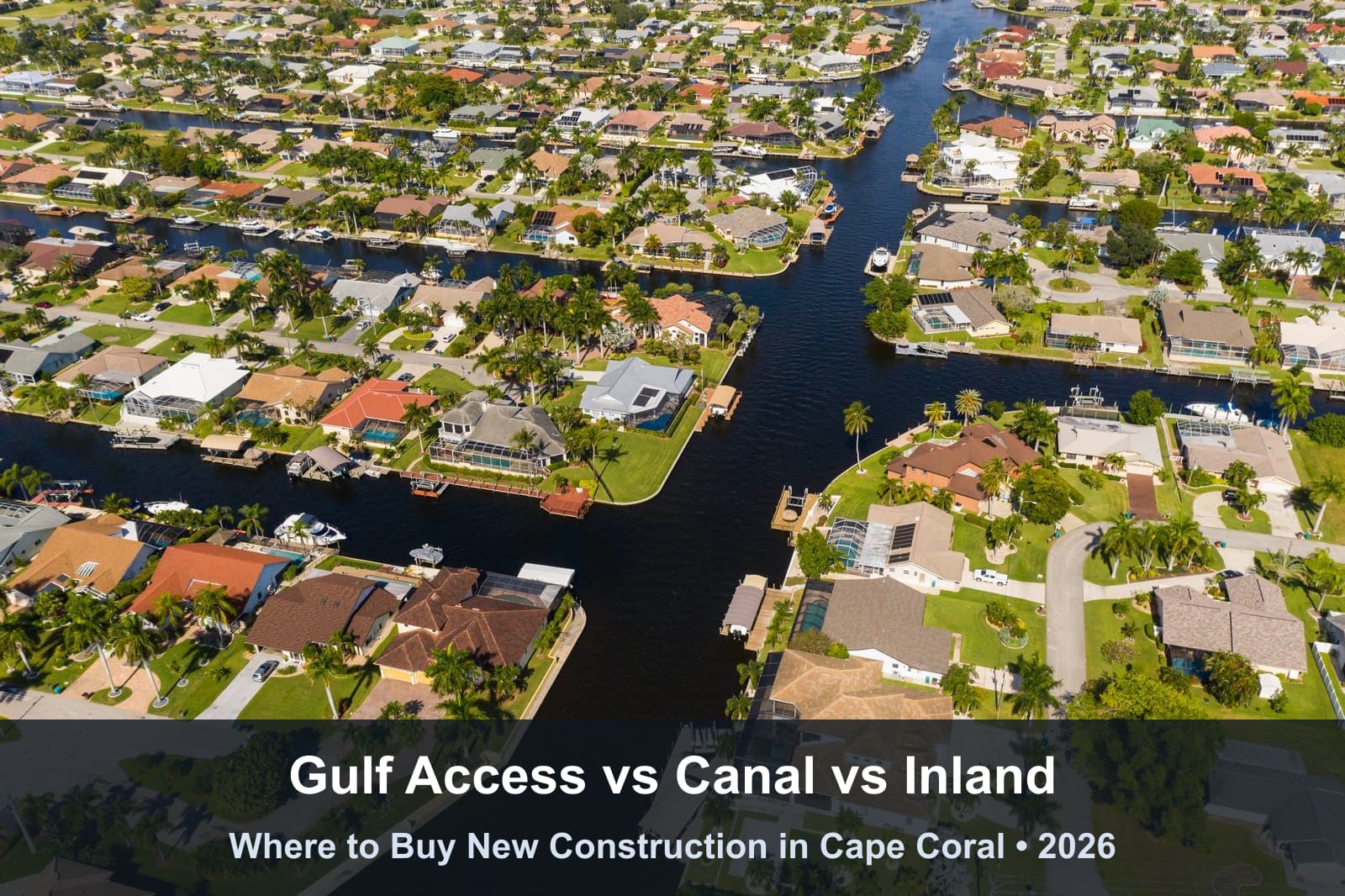
You found two new-construction homes. Same builder. Same floor plan. Same three-car garage. One's priced in the low $300s, the other's knocking on a million. You stare at the listings trying to figure out what you're missing.
You're missing the water.
Cape Coral has over 400 miles of navigable canals — more than any city on Earth, Venice included. That web of water is the entire reason this place exists, and it's the single biggest thing separating one price tag from another. Two identical houses can sit a mile apart and be worth half a million dollars apart, and the only difference is what's behind them. So before you fall for a floor plan, you need to learn to read the water the way somebody who sells here does. Let's fix that right now.
The Four Lots, Ranked by What's Out Back
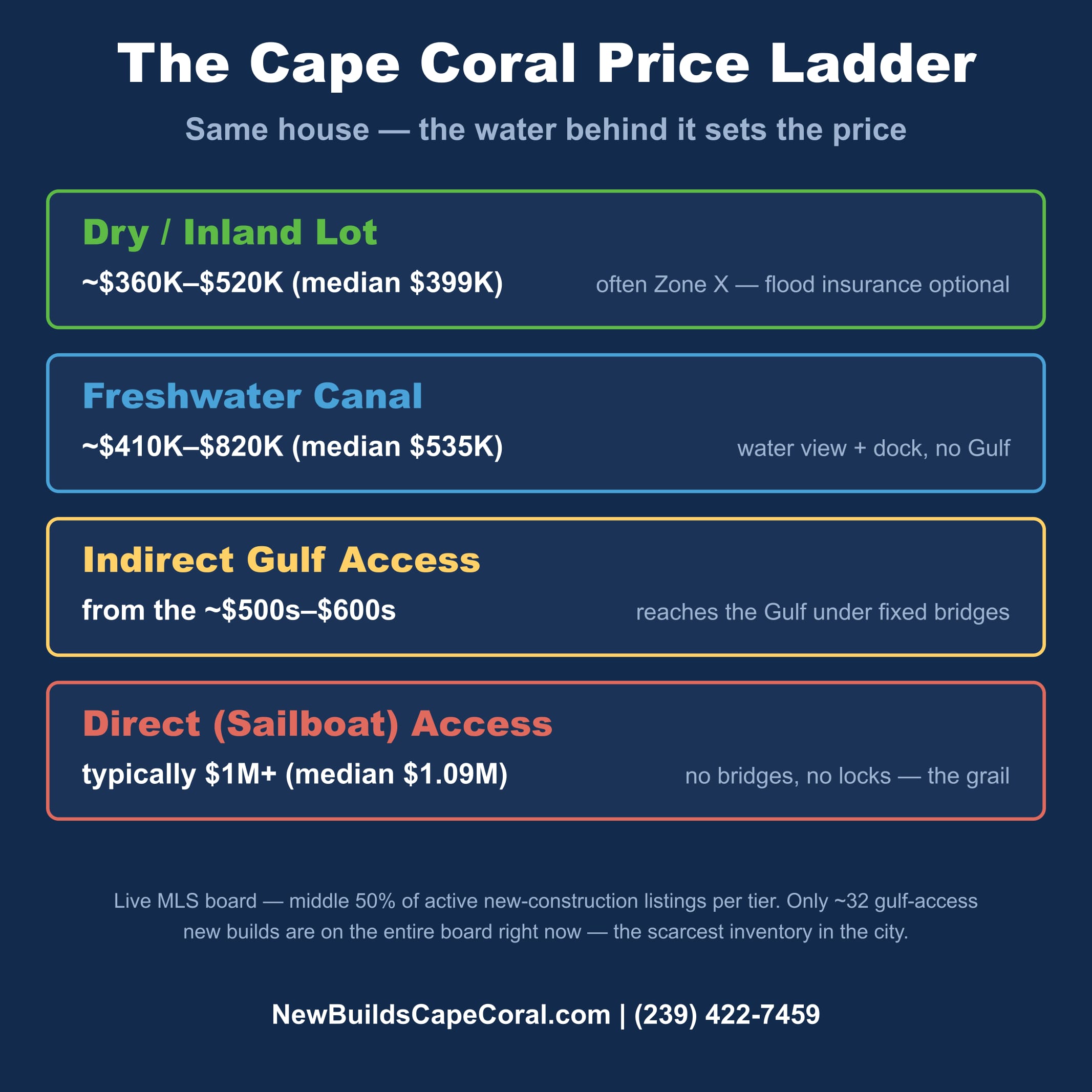
Every new build in the Cape sits on one of four kinds of ground. Here's the honest ladder, cheapest to priciest — with the typical price range straight off our live MLS board:
| What's behind the house | What it means | Typical new-build range* | Flood zone tendency |
|---|---|---|---|
| Dry / inland lot | No canal. Higher, drier ground — often Zone X | ~$360K–$520K (median $399K) | More often X (insurance optional) |
| Freshwater canal | Water view + kayak/fish, but landlocked. No Gulf | ~$410K–$820K (median $535K) | Mixed X / AE |
| Indirect gulf access | Reaches the Gulf, but under fixed bridges | from the ~$500s–$600s | Usually AE |
| Direct (sailboat) access | Open water, no bridges, no locks | typically $1M+ (gulf-access median $1.09M) | AE, some VE near the river |
*Live ranges from our MLS board — the middle 50% of active new-construction listings per tier. The MLS doesn't tag bridge clearance, so the split between indirect and direct within gulf-access reflects local experience, not a data field.
See the jumps? The big one isn't dry-to-freshwater. It's freshwater-to-gulf-access. The moment your backyard can actually reach open water, the price grabs an elevator. Understand why, and you'll know exactly which rung fits your life and your budget.
Direct Gulf Access: The Boater's Grail (and the Price to Match)
"Direct gulf access" — locals also say sailboat access — means exactly what it sounds like: no bridges, no locks, nothing between your seawall and the Caloosahatchee River but open canal. You can run a 40-foot sportfisher or a tall-masted sailboat out to San Carlos Bay whenever the mood hits, no clearance math, no waiting.
That freedom clusters in specific spots. The Yacht Club and Bimini Basin area in the southeast, and Cape Harbour and Tarpon Point in the southwest, are the classic direct-access addresses. New construction on true sailboat-access lots is the rarest, most expensive inventory in the city — as of this writing, only about 32 new builds on the entire board reach navigable water at all, direct and indirect combined — because they aren't making more of that water.
Here's the honest part most listings won't tell you: a "gulf access" tag doesn't automatically mean direct. Plenty of homes marketed as gulf access are actually the next rung down. Read the fine print, or better yet, ask us to pull the real classification before you get excited.
Indirect Access: Same Gulf, Now Do the Bridge Math
Indirect gulf access still gets you to the Gulf — you just duck under one or more fixed bridges to get there. And in Cape Coral, those bridges run low. Clearances commonly sit in the 9-to-15-foot range, and some are lower at a king tide than the sign claims.
So indirect access is the "sailboats need not apply" tier. If your boat is a center console, a bay boat, or a pontoon that clears those bridges, you barely notice — you're still out fishing the passes by lunch. If you dream of a flybridge or a mast, that bridge is a hard ceiling.
The payoff is real money saved. Indirect-access new builds often run a couple hundred grand under a comparable direct-access home on the same water system. For a huge share of buyers, that's the smart lane: real Gulf boating, minus the sailboat premium you were never going to use anyway.
Freshwater Canal: The View Without the Ocean
Then there's freshwater. These are the landlocked canals — big stretches of the northeast and northwest Cape — with no connection to the river at all. Stormwater-fed, quiet, great for kayaks, paddleboards, and a surprising amount of bass and cichlid fishing off your own dock.
What you're buying here is the water view and the backyard serenity without paying the gulf-access tax. You get the wide-canal look, the sunrise off the lanai, a dock for the kayak — and a price much closer to a dry lot than to sailboat access. For buyers who love the water but don't own a boat (or won't cry about trailering it to a ramp), freshwater is the quietly brilliant value play in this city.
The Local Fact That Just Rewrote the Map
Here's something no national portal knows to tell you, and it happened recently enough that even some local listings haven't caught up.
For decades, a chunk of southwest Cape Coral sat behind the Chiquita Boat Lock — a lock on the South Spreader canal that every boater in that area had to cycle through to reach open water, adding real time to every trip. The city removed it, and demolition finished June 17, 2025. That whole southwest section now has faster, unrestricted runs to the Gulf than it did a couple summers ago. (The old Ceitus barrier up in the northwest spreader came out back in 2008 for similar reasons.)
Why do you care? Because access improvements like that ripple straight into value, and the buyers who understand the change get ahead of the ones who don't. If you're shopping the southwest Cape, this is exactly the kind of thing worth a conversation before you write an offer.
Listen Up: How to Actually Choose
Forget "waterfront good, inland bad." That's not how a local thinks. Here's the real decision.
Own a big boat or a sailboat? You need direct access, full stop — don't waste a dime on a home you'll be stuck trailering out of. Own a smaller boat, or planning to? Indirect access likely gets you 90% of the joy for a lot less. Love the water but don't run a boat? Freshwater canal hands you the view and the dock for near-dry-lot money — the most underrated buy in the Cape. Rather have higher, drier ground where flood insurance is often optional, and put the savings into the house itself? Inland is a completely legitimate answer, and half the out-of-state buyers who swear they need water end up thrilled they went dry.
The mistake to avoid: buying "gulf access" because it sounds prestigious, then realizing your boat clears the bridges fine and you overpaid for a category you didn't need. Match the water to your actual life — not the listing's adjectives.
Key Takeaways
- Cape Coral's 400+ miles of canals mean the same house can swing six figures based purely on what's out back.
- Direct (sailboat) access = no bridges, no locks, any boat, top dollar. Concentrated around the Yacht Club, Bimini Basin, Cape Harbour, and Tarpon Point.
- Indirect access reaches the Gulf under fixed bridges (roughly 9–15 ft) — great for smaller boats, and a couple hundred grand cheaper.
- Freshwater canals are landlocked: the water view and a dock, minus the Gulf and minus the premium. The value sleeper.
- Inland/dry lots sit higher and drier, more often in Zone X where flood insurance isn't required — a smart, cheaper base for the money you'd rather spend on the home.
- The Chiquita Lock came out June 17, 2025, upgrading southwest Cape access — a real, recent value shift most portals don't flag.
See What's Actually Available
The market moves every week as homes list and close. Shop it by the thing that actually drives Cape Coral prices — the water:
- ⭐ Gulf-access new construction (navigable water)
- All waterfront & canal new construction — including freshwater
- Every active new build in Cape Coral
- New construction under $400K (great for inland/dry lots)
Not sure whether the home you love is true sailboat access, indirect, freshwater, or dry — or whether you're about to overpay for a category you won't use? That's the whole reason we're here.
If you need help buying new construction in Cape Coral, call us at (239) 422-7459 and we'll tell you straight which water you're actually looking at, what it should cost, and whether it fits the boat in your driveway.
Frequently Asked Questions
What does "gulf access" actually mean in Cape Coral?
It means the canal behind the home connects to the Caloosahatchee River and out to the Gulf. But there are two flavors: direct (sailboat) access with no bridges or locks in the way, and indirect access that routes under fixed bridges. They aren't priced the same, and a listing that just says "gulf access" could be either — always confirm which before you value the home.
What's the difference between a freshwater canal and a gulf-access canal?
A gulf-access canal connects to open water, so you can boat to the Gulf. A freshwater canal is landlocked — it's a stormwater system with no river connection, great for kayaking and fishing but not for boating out to sea. Freshwater homes cost significantly less than comparable gulf-access homes and more often sit in lower-cost flood zones.
Is a boat too tall for the bridges on indirect-access canals?
Possibly. Cape Coral's fixed bridges commonly clear somewhere in the 9-to-15-foot range, and real clearance drops at high tide. Center consoles, bay boats, and pontoons usually pass fine; flybridge boats and sailboats often can't. If you have (or want) a tall boat, you need direct access, not indirect.
Did removing the Chiquita Lock change anything for buyers?
Yes. The lock in southwest Cape Coral was removed as of June 17, 2025, giving that area faster, unrestricted access to open water than before. Improved access tends to support value, so if you're shopping the southwest Cape, it's worth understanding which addresses benefited.
Is it worth buying inland instead of on a canal?
For a lot of buyers, absolutely. Inland lots sit on higher, drier ground — more often in Zone X where flood insurance isn't federally required — and cost meaningfully less than waterfront. If you're not a boater, buying dry and putting the savings into the house (or the pool) is often the sharper financial move.
See every new construction home in Cape Coral — live
Straight off the Southwest Florida MLS, refreshed every 15 minutes, with the flood zone, utilities and builder on every card.
Keep reading
All guides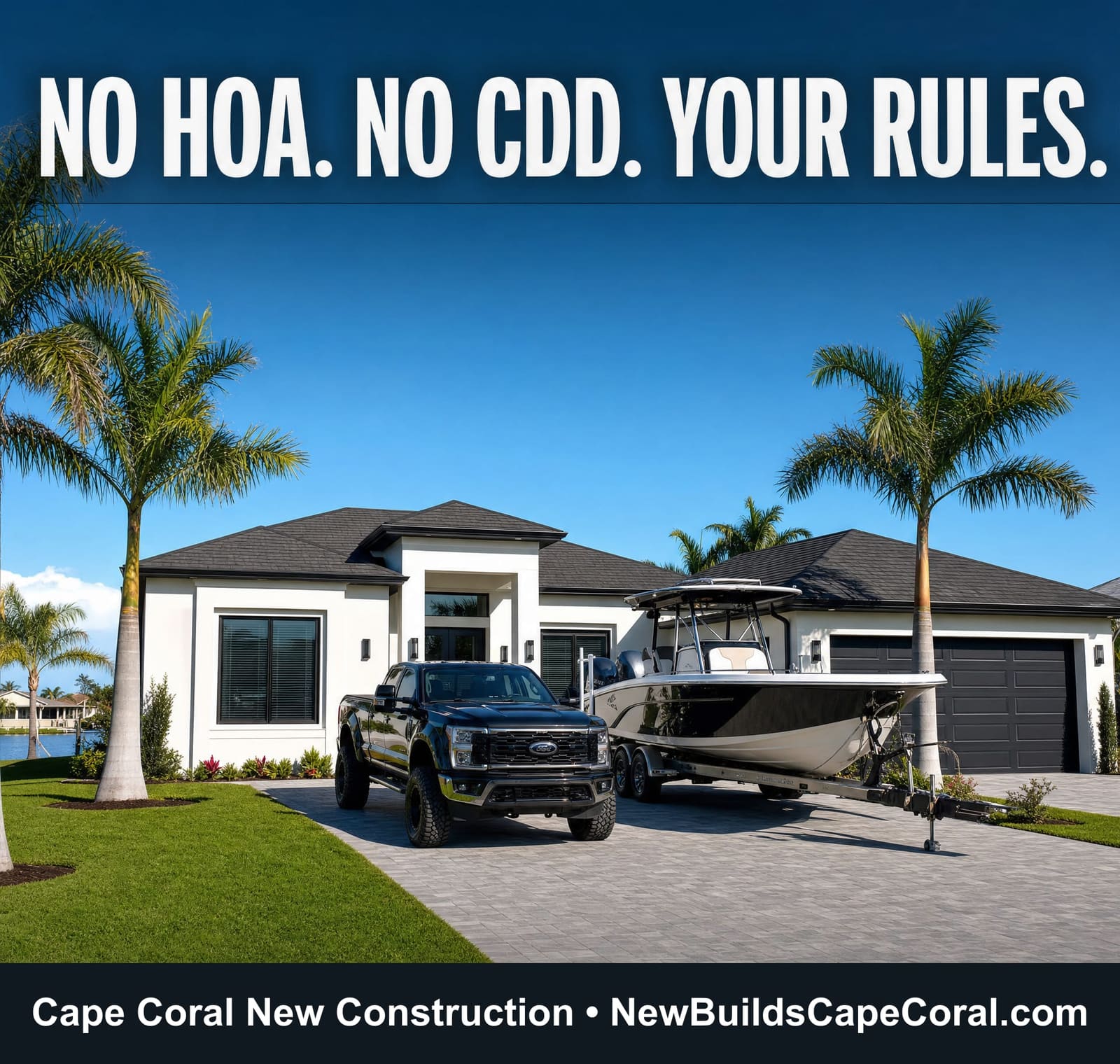
Buyer Guides
No HOA, No CDD in Cape Coral: The Freedom (and the $200–$500 a Month) Most Florida Buyers Never Get
6 min read
Buyer Guides
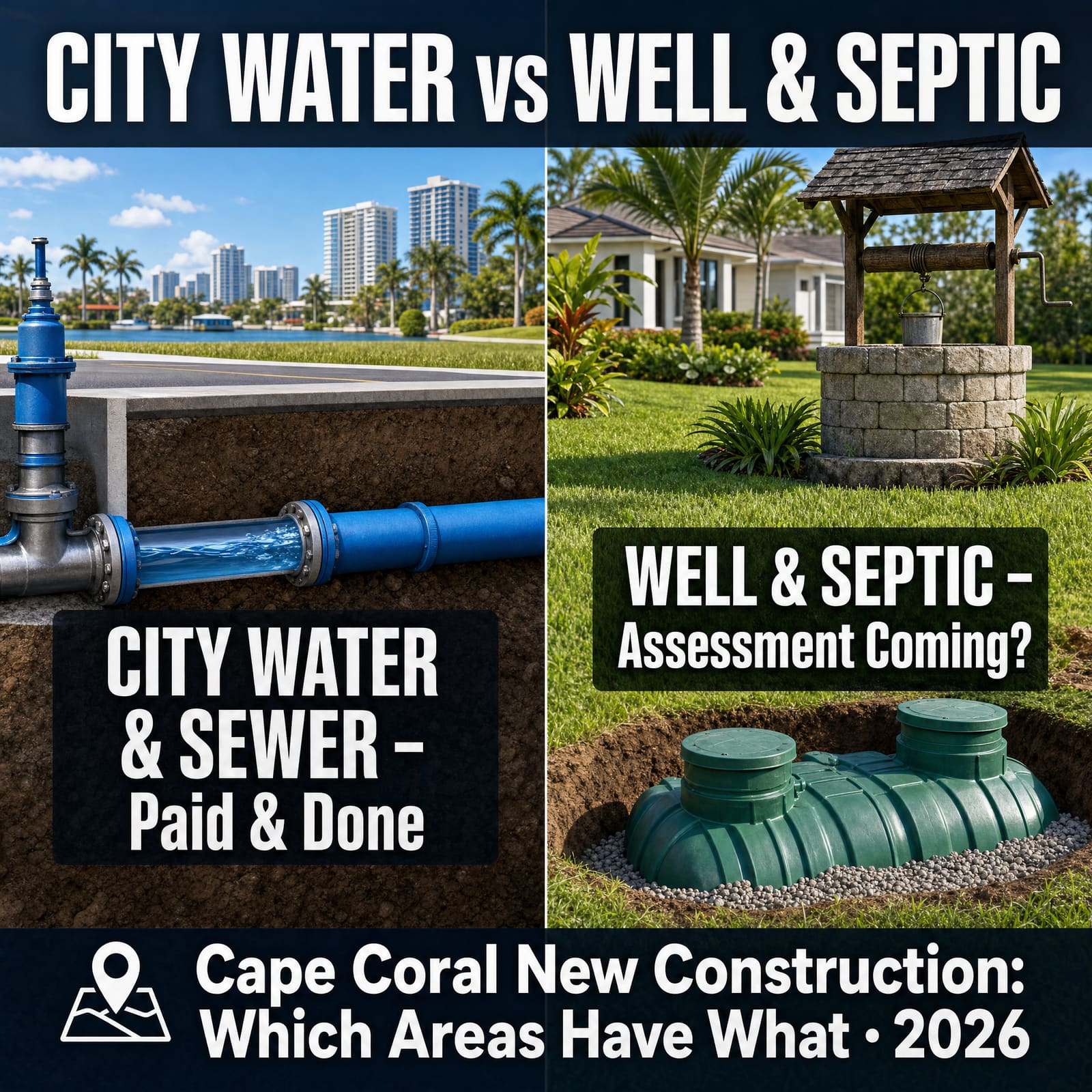
City Water & Sewer vs Septic in Cape Coral New Construction: Which Areas Have What (2026)
8 min read
Buyer Guides
Moving from Miami to Cape Coral: Why East Coast Buyers Are Trading the Condo for a Canal (2026)
7 min read